Year 8 · English · Drama: writing scenes · Lesson 2
Sentences and punctuation for effect
Sentence types, lengths, openers and punctuation (ellipsis, dash, colon, semicolon) used deliberately for effect in creative writing.
20-minute video lesson
Teaching, worked examples and 20 practice questions solved step by step.
Watch free for a monthWhat your child will learn
- Identify simple, compound, complex and minor sentences
- Use sentence length to control pace
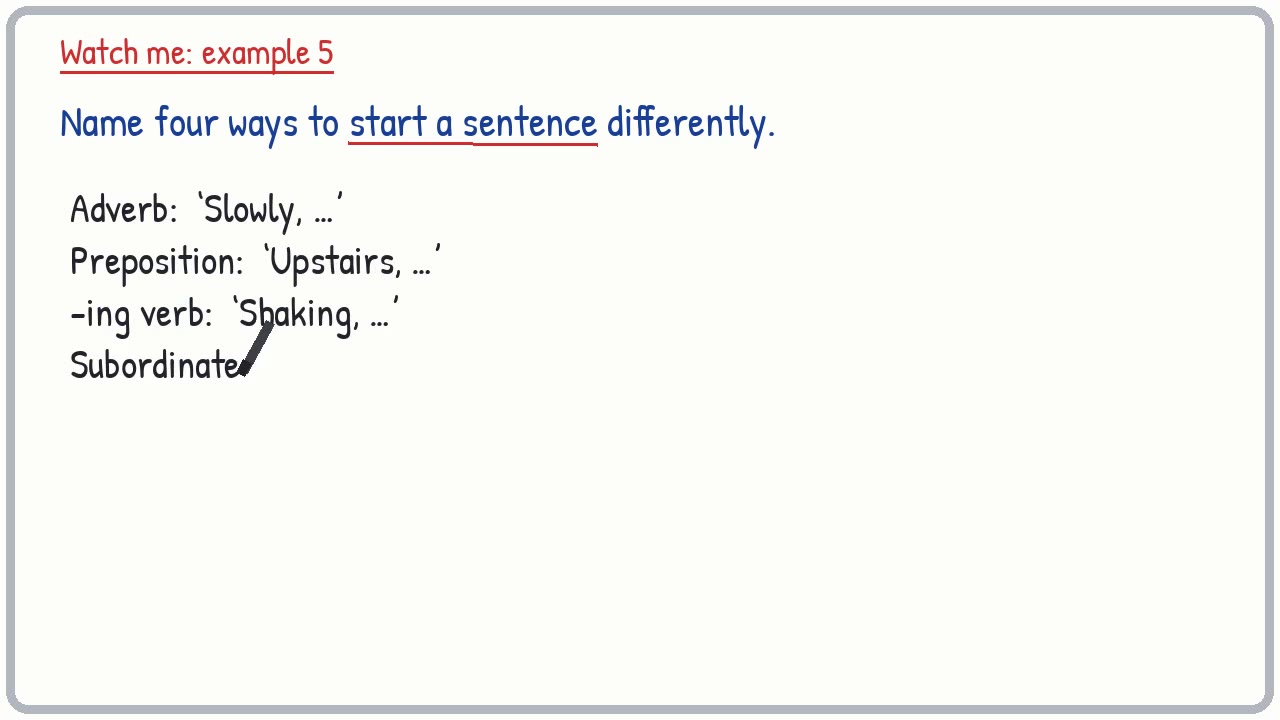
- Vary sentence openers
- Use punctuation for effect
The method
- Mix sentence types.
- Use length to control pace.
- Vary openers.
- Use punctuation for effect.
Key words: simple sentence, compound sentence, complex sentence, subordinate clause, minor sentence, ellipsis, semicolon.
Worked examples
The first three practice questions from the lesson, with every step.
Question 1
What is a simple sentence?
- Step 1: One main clause: subject + verb
- Step 2: e.g. ‘The door creaked.’
Answer: One main clause, e.g. ‘The door creaked.’
Question 2
What is a compound sentence?
- Step 1: Two main clauses + a conjunction (and, but, so)
- Step 2: e.g. ‘The light flickered, but I kept walking.’
Answer: Two main clauses joined by and/but/so
Question 3
What is a complex sentence?
- Step 1: Main clause + subordinate clause
- Step 2: e.g. ‘Although I was scared, I opened the door.’
Answer: Main clause + subordinate clause