Year 8 · Maths · Coordinates and straight lines · Lesson 3
Gradient and y = mx + c
Learn what the gradient of a line means, find it from a graph by counting squares, find the y-intercept, and use y = mx + c to read, write and draw straight lines, including parallel lines.
31-minute video lesson
Teaching, worked examples and 20 practice questions solved step by step.
Watch free for a monthWhat your child will learn
- Understand gradient as steepness
- Find the gradient of a line from a graph
- Find the y-intercept of a line
- Use y = mx + c to identify gradient and intercept
- Recognise parallel lines and draw lines from their equations
The method
- In y = mx + c, m is the gradient and c is the y-intercept.
- Gradient = how far up for every 1 across.
- Uphill is positive, downhill is negative.
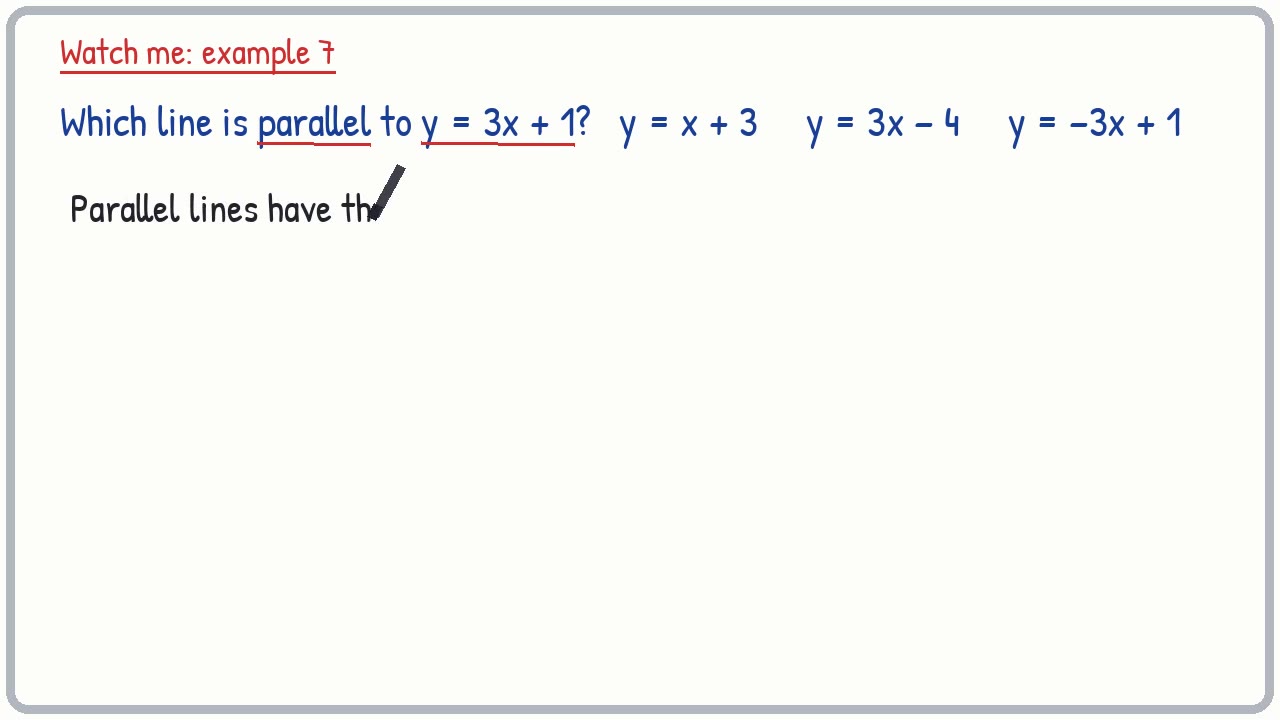
- Parallel lines have the same gradient.
Key words: gradient, y-intercept, y = mx + c, parallel, steepness.
Worked examples
The first three practice questions from the lesson, with every step.
Question 1
Write down the gradient and y-intercept of y = 2x + 7.
- Step 1: Compare with y = mx + c
- Step 2: m = 2 (the number in front of x)
- Step 3: c = 7 (the number on its own)
Answer: gradient 2, y-intercept 7
Question 2
Write down the gradient and y-intercept of y = 5x − 2.
- Step 1: Compare with y = mx + c
- Step 2: m = 5 (the number in front of x)
- Step 3: c = −2 (the number on its own)
Answer: gradient 5, y-intercept −2
Question 3
Write down the gradient and y-intercept of y = −x + 4.
- Step 1: Compare with y = mx + c
- Step 2: m = −1 (the number in front of x)
- Step 3: c = 4 (the number on its own)
Answer: gradient −1, y-intercept 4