Year 8 · Maths · Tables and probability · Lesson 1
Sample spaces and probability
Learn to list outcomes systematically, draw sample space diagrams for two dice or spinners, find probabilities, use P(not) = 1 − P, and work out expected outcomes.
32-minute video lesson
Teaching, worked examples and 20 practice questions solved step by step.
Watch free for a monthWhat your child will learn
- List all outcomes of two events systematically
- Draw and use a sample space diagram
- Find probabilities as fractions
- Use the fact that P(not A) = 1 − P(A)
- Work out expected outcomes
The method
- Draw a grid with one event down the side and one across the top.
- Fill in every outcome.
- Count the outcomes you want.
- Probability = wanted ÷ total; simplify.
Key words: probability, outcome, sample space, equally likely, expected.
Worked examples
The first three practice questions from the lesson, with every step.
Question 1
A coin is thrown twice. List all the possible outcomes.
- Step 1: Go through every first throw with every second throw.
- Step 2: HH, HT
- Step 3: TH, TT
- Step 4: 2 × 2 = 4 outcomes
Answer: 4 outcomes
Question 2
A spinner with A, B, C is spun and a coin is thrown. List all the possible outcomes.
- Step 1: Go through every letter with every coin result.
- Step 2: AH, AT
- Step 3: BH, BT
- Step 4: CH, CT
- Step 5: 3 × 2 = 6 outcomes
Answer: 6 outcomes
Question 3
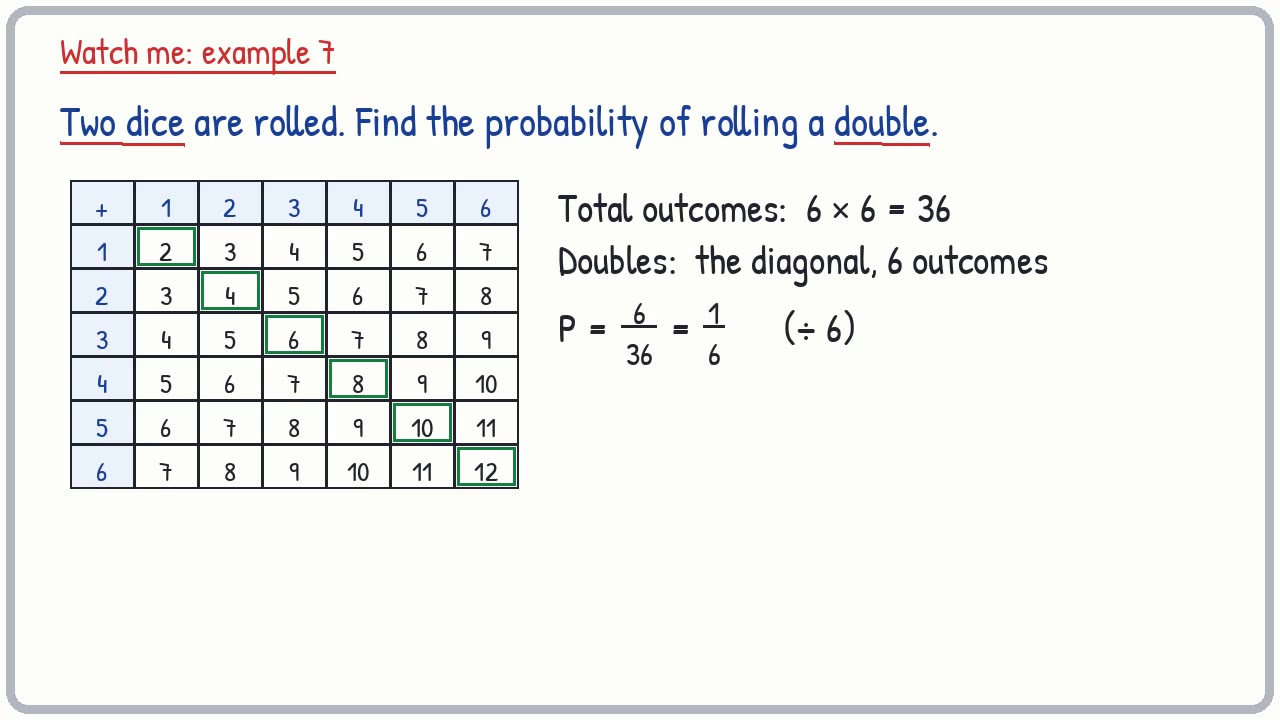
Two dice are rolled and the scores added. Find the probability of a total of 7.
- Step 1: Draw the sample space diagram
- Step 2: Total outcomes: 6 × 6 = 36
- Step 3: Total 7: 6 outcomes
- Step 4: P = 6/36
- Step 5: 6/36 = 1/6 (÷ 6)
Answer: 1/6