Year 8 · Maths · Sequences and the nth term · Lesson 3
Using the nth term
Use the nth term to decide whether a number is in a sequence, find which term has a given value, and find the first term above or below a value.
31-minute video lesson
Teaching, worked examples and 20 practice questions solved step by step.
Watch free for a monthWhat your child will learn
- Decide whether a number is a term of a sequence
- Find which term has a given value
- Find the first term greater than or less than a value
- Solve problems using the nth term
- Explain properties of sequences
The method
- Make the nth term equal to the number.
- Solve to find n.
- Whole number: it's a term. Not whole: it isn't.
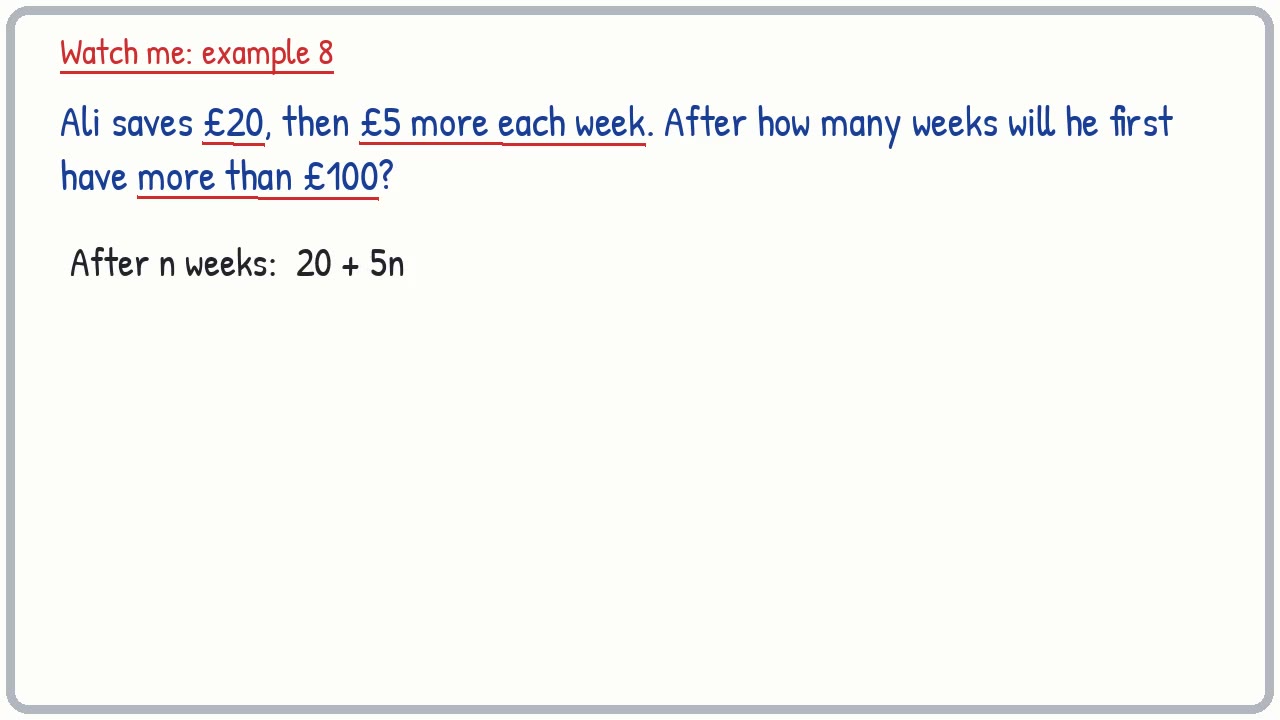
- For 'first term greater than', solve an inequality and round n up.
Key words: nth term, position, term, whole number, inequality.
Worked examples
The first three practice questions from the lesson, with every step.
Question 1
The nth term of a sequence is 2n + 5. Which term is equal to 45?
- Step 1: 2n + 5 = 45
- Step 2: 2n = 40
- Step 3: n = 40 ÷ 2 = 20
- Step 4: Check: 2 × 20 + 5 = 45
Answer: The 20th term
Question 2
The nth term of a sequence is 4n − 1. Which term is equal to 79?
- Step 1: 4n − 1 = 79
- Step 2: 4n = 80
- Step 3: n = 80 ÷ 4 = 20
- Step 4: Check: 4 × 20 − 1 = 79
Answer: The 20th term
Question 3
The nth term of a sequence is 7n + 3. Which term is equal to 73?
- Step 1: 7n + 3 = 73
- Step 2: 7n = 70
- Step 3: n = 70 ÷ 7 = 10
- Step 4: Check: 7 × 10 + 3 = 73
Answer: The 10th term