Year 8 · Science · Elements, compounds and the periodic table · Lesson 2
Compounds, mixtures and formulae
What compounds and mixtures are, how to tell them apart in particle diagrams, counting atoms in chemical formulae, and naming compounds.
27-minute video lesson
Teaching, worked examples and 20 practice questions solved step by step.
Watch free for a monthWhat your child will learn
- Describe compounds and mixtures
- Identify elements, compounds and mixtures in particle diagrams
- Count the atoms in a chemical formula
- Name simple compounds using -ide and -ate
- Explain why compounds have different properties from their elements
The method
- A compound is two or more different elements chemically joined, with new properties.
- A mixture is substances not chemically joined, so they're easy to separate.
- In a formula, the small number counts the atom just before it; no number means 1.
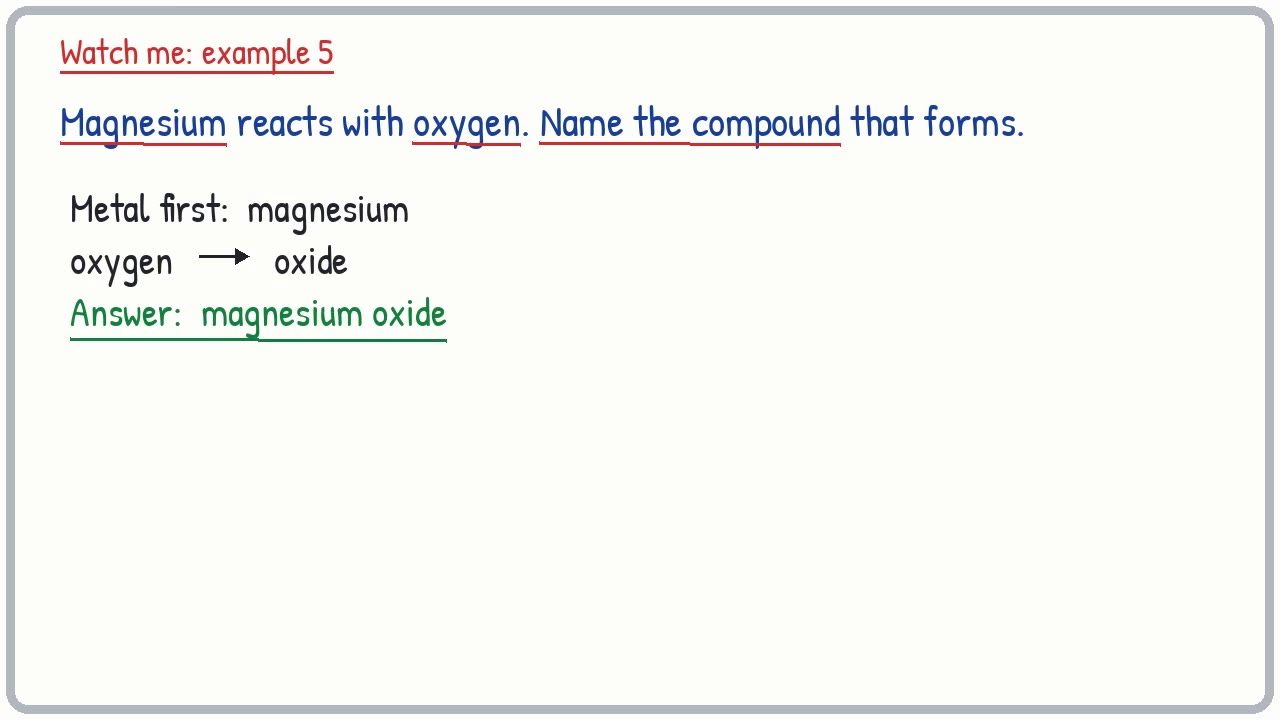
- Naming: metal first; -ide for two elements; -ate when oxygen is also present.
Key words: compound, mixture, formula, chemically joined, -ide, -ate, molecule.
Worked examples
The first three practice questions from the lesson, with every step.
Question 1
How many atoms of each element are in CO₂ (carbon dioxide)? How many atoms in total?
- Step 1: Elements: carbon, oxygen
- Step 2: 1 C, 2 O
- Step 3: Total: 1 + 2 = 3
Answer: 1 C, 2 O; 3 atoms in total
Question 2
How many atoms of each element are in NH₃ (ammonia)? How many atoms in total?
- Step 1: Elements: nitrogen, hydrogen
- Step 2: 1 N, 3 H
- Step 3: Total: 1 + 3 = 4
Answer: 1 N, 3 H; 4 atoms in total
Question 3
How many atoms of each element are in CH₄ (methane)? How many atoms in total?
- Step 1: Elements: carbon, hydrogen
- Step 2: 1 C, 4 H
- Step 3: Total: 1 + 4 = 5
Answer: 1 C, 4 H; 5 atoms in total