Year 8 · Science · Electricity and magnetism · Lesson 1
Current and circuits
What electric current is, circuit symbols, and how current behaves in series and parallel circuits, with ammeter readings.
25-minute video lesson
Teaching, worked examples and 20 practice questions solved step by step.
Watch free for a monthWhat your child will learn
- Describe electric current and its unit
- Recognise and draw circuit symbols
- Find currents in series circuits
- Find currents in parallel circuits
- Compare series and parallel circuits
The method
- Current is a flow of charge, measured in amps (A) with an ammeter in series.
- Series circuit: one loop, and the current is the same everywhere.
- Parallel circuit: branches, and the branch currents add up to the total.
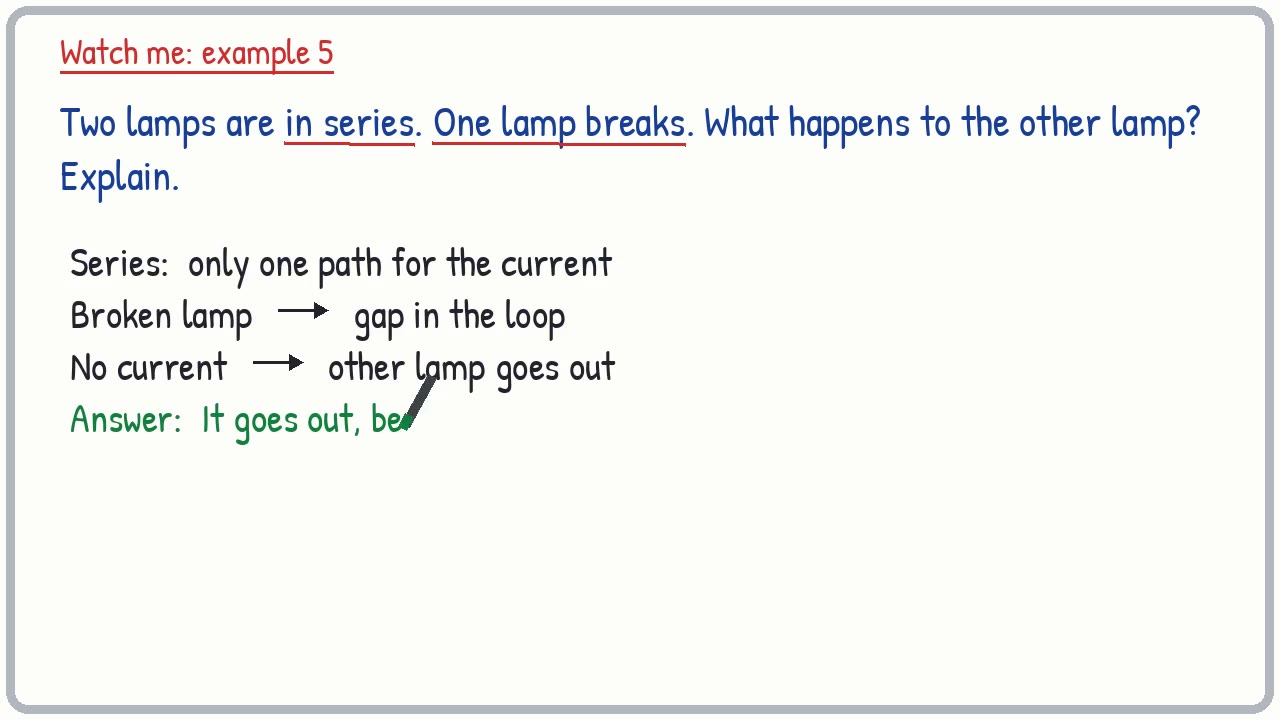
- A break in a series circuit stops all current; parallel branches work independently.
Key words: current, amp, ammeter, series, parallel, circuit symbol, cell, battery, electron.
Worked examples
The first three practice questions from the lesson, with every step.
Question 1
In this series circuit, ammeter A₁ reads 0.5 A. What do ammeters A₂ and A₃ read?
- Step 1: Look at the circuit
- Step 2: Series: the current is the same everywhere
- Step 3: A₂ = 0.5 A, A₃ = 0.5 A
Answer: Both read 0.5 A
Question 2
In this series circuit, ammeter A₁ reads 0.2 A. What do ammeters A₂ and A₃ read?
- Step 1: Look at the circuit
- Step 2: Series: the current is the same everywhere
- Step 3: A₂ = 0.2 A, A₃ = 0.2 A
Answer: Both read 0.2 A
Question 3
In this parallel circuit, A₁ reads 0.3 A and A₂ reads 0.3 A. What does A₃ read?
- Step 1: Look at the circuit
- Step 2: Parallel: branch currents add up to the total
- Step 3: A₃ = 0.3 + 0.3 = 0.6 A
Answer: 0.6 A