Year 8 · Science · Nutrition and digestion · Lesson 3
Enzymes and digestion
What enzymes are, the lock and key model, the three digestive enzymes and their products, and how temperature and pH affect enzymes.
23-minute video lesson
Teaching, worked examples and 20 practice questions solved step by step.
Watch free for a monthWhat your child will learn
- Explain what an enzyme is
- Describe the lock and key model
- Name amylase, protease and lipase and their products
- Explain how temperature and pH affect enzymes
- Interpret results from enzyme experiments
The method
- Enzymes are biological catalysts: they speed up reactions without being used up.
- The substrate fits the enzyme's active site (lock and key); enzymes are specific.
- Amylase: starch to sugars. Protease: protein to amino acids. Lipase: lipids to fatty acids and glycerol.
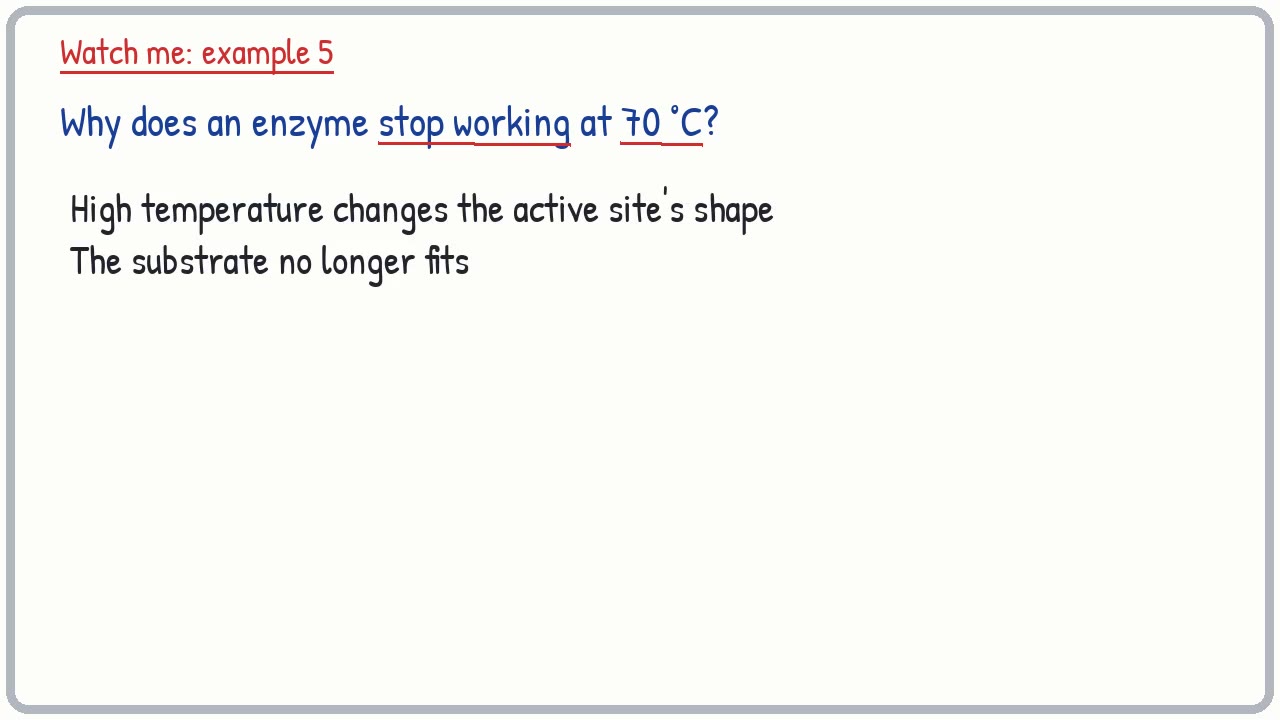
- Enzymes work best at 37 °C; too hot and they are denatured.
Key words: enzyme, catalyst, active site, substrate, amylase, protease, lipase, denatured, optimum.
Worked examples
The first three practice questions from the lesson, with every step.
Question 1
What does amylase break down, and what does it make?
- Step 1: Amylase: starch
- Step 2: starch → sugars (glucose)
Answer: Starch into sugars (glucose)
Question 2
What does lipase break down, and what does it make?
- Step 1: Lipase: lipids (fats)
- Step 2: lipids (fats) → fatty acids and glycerol
Answer: Lipids (fats) into fatty acids and glycerol
Question 3
Name the enzyme that digests protein.
- Step 1: Protein → protease
Answer: Protease