Year 8 · English · Gothic fiction · Lesson 5
Writing a Gothic opening
Planning and writing a Gothic story opening: the writer's toolkit, show don't tell, and building to a hook.
24-minute video lesson
Teaching, worked examples and 20 practice questions solved step by step.
Watch free for a monthWhat your child will learn
- Plan a Gothic opening
- Use Gothic techniques in writing
- Show rather than tell emotions
- Vary sentence lengths for effect
- End with a hook
The method
- Plan the setting, character, threat and a hook.
- Use Gothic techniques: pathetic fallacy, personification, similes, the senses.
- Vary sentence length, with short sentences for impact.
- Show, don't tell; hint at the threat instead of revealing it.
Key words: plan, hook, show don't tell, pathetic fallacy, personification, simile, sentence variety.
Worked examples
The first three practice questions from the lesson, with every step.
Question 1
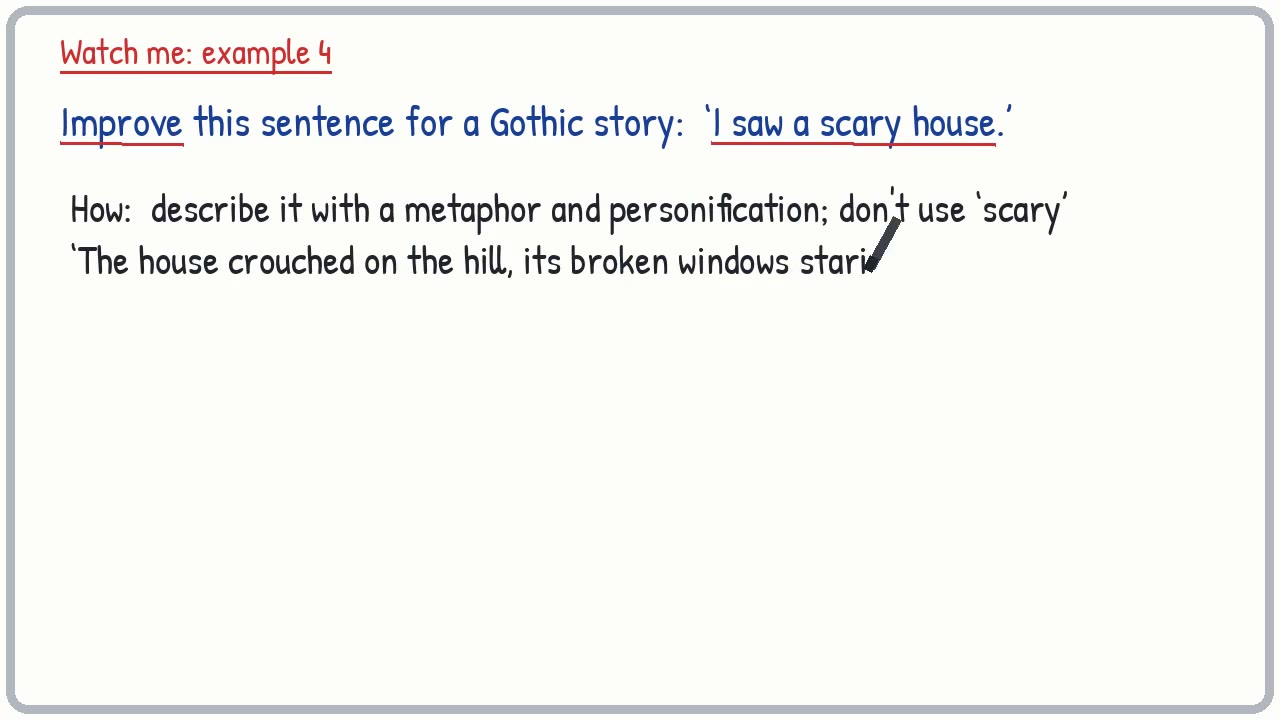
Improve this sentence for a Gothic story: ‘The house was old.’
- Step 1: How: show its age through decay
- Step 2: ‘Ivy choked the crumbling walls, and the shutters hung like broken wings.’
Answer: e.g. ‘Ivy choked the crumbling walls, and the shutters hung like broken wings.’
Question 2
Improve this sentence for a Gothic story: ‘I was scared.’
- Step 1: How: show fear through the body, not by naming it
- Step 2: ‘My heart hammered against my ribs, and my hands would not stop shaking.’
Answer: e.g. ‘My heart hammered against my ribs, and my hands would not stop shaking.’
Question 3
Improve this sentence for a Gothic story: ‘I heard a noise.’
- Step 1: How: make the noise specific and unexplained
- Step 2: ‘From somewhere below came a slow, dragging scrape, then silence.’
Answer: e.g. ‘From somewhere below came a slow, dragging scrape, then silence.’