Year 8 · Maths · Area of trapezia and circles · Lesson 1
Area of a trapezium
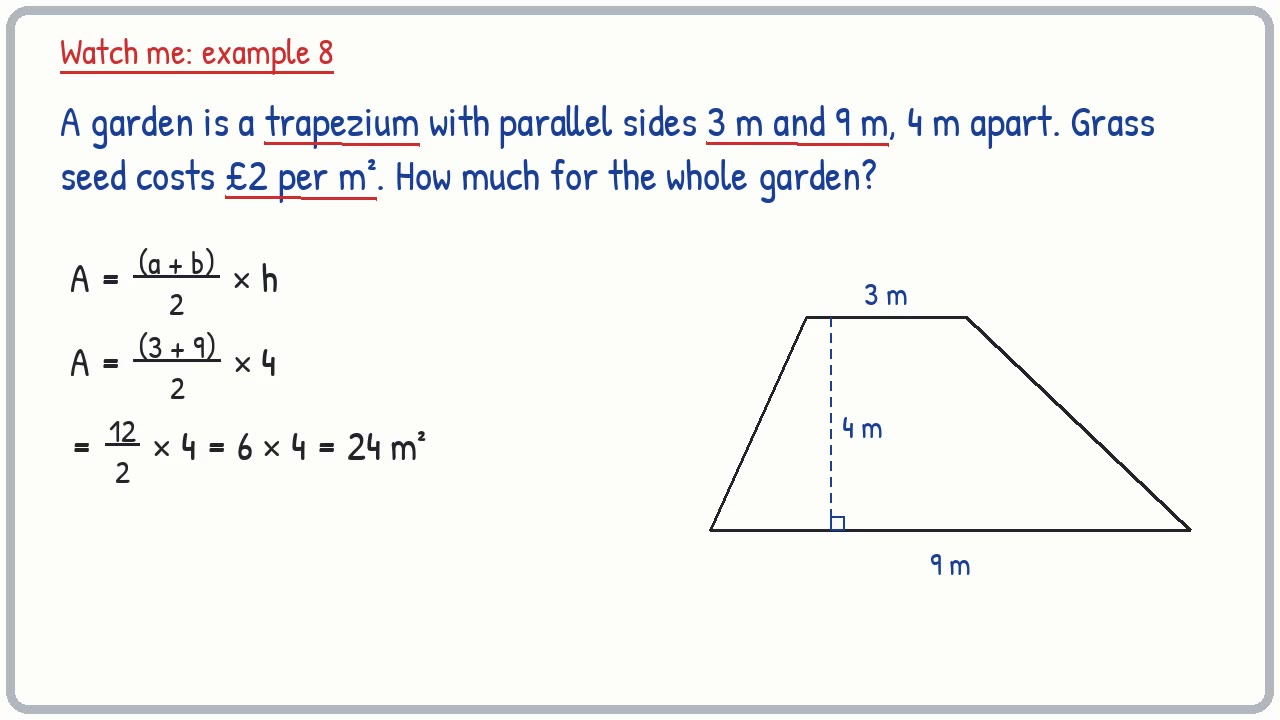
Find areas of rectangles, parallelograms and triangles, then use A = (a + b)/2 × h for trapezia, including finding a missing height.
28-minute video lesson
Teaching, worked examples and 20 practice questions solved step by step.
Watch free for a monthWhat your child will learn
- Recall area formulas for rectangles, parallelograms and triangles
- Understand where the trapezium formula comes from
- Find the area of a trapezium
- Find a missing length from the area
- Solve problems involving area
The method
- Find the parallel sides a and b.
- Find the perpendicular height h.
- Area = (a + b) ÷ 2 × h.
- Area units are squared, like cm².
Key words: area, trapezium, parallel, perpendicular height, square units.
Worked examples
The first three practice questions from the lesson, with every step.
Question 1
A rectangle has base 8 cm and perpendicular height 6 cm. Find its area.
- Step 1: A = b × h
- Step 2: A = 8 × 6 = 48 cm²
Answer: 48 cm²
Question 2
A parallelogram has base 12 cm and perpendicular height 4 cm. Find its area.
- Step 1: A = b × h
- Step 2: A = 12 × 4 = 48 cm²
Answer: 48 cm²
Question 3
A triangle has base 10 cm and perpendicular height 9 cm. Find its area.
- Step 1: A = 1/2 × b × h
- Step 2: A = 1/2 × 10 × 9 = 45 cm²
Answer: 45 cm²