Year 8 · Maths · Multiplicative change · Lesson 1
Direct proportion
Learn the unitary method for direct proportion: find the value of one, then multiply. Includes shopping, recipes, rates, best buys and checking whether two amounts are in proportion.
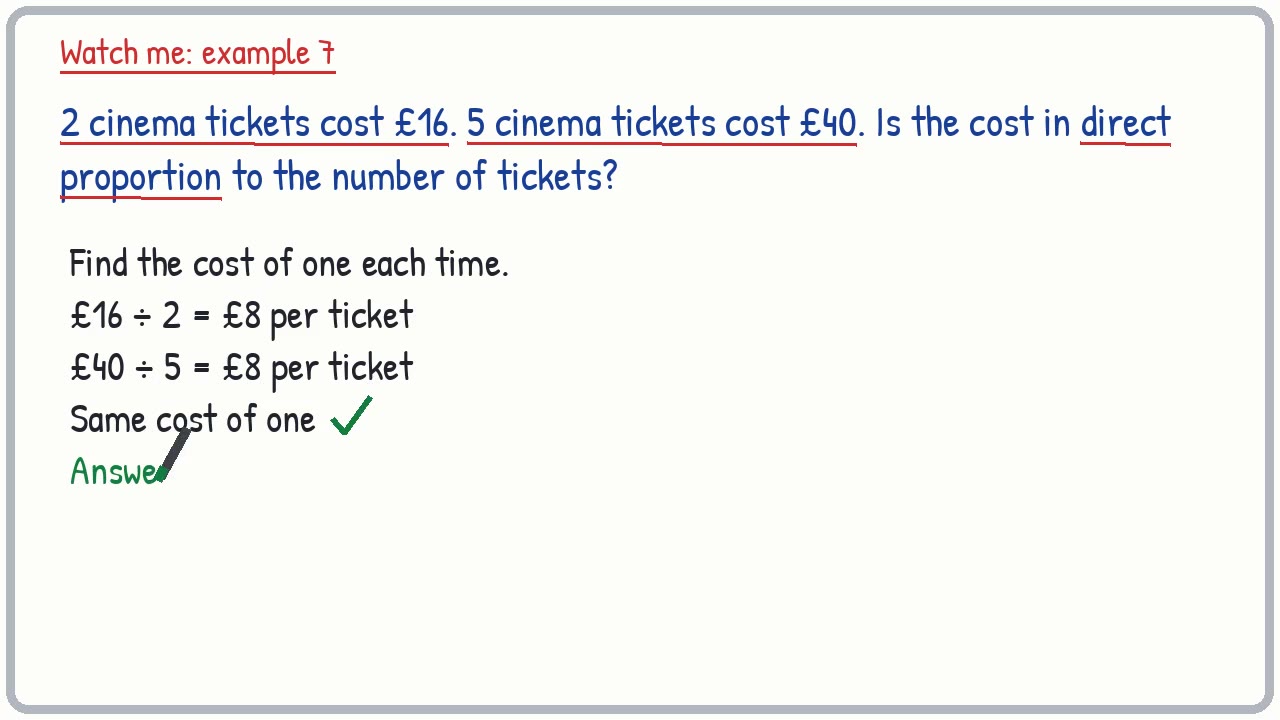
35-minute video lesson
Teaching, worked examples and 20 practice questions solved step by step.
Watch free for a monthWhat your child will learn
- Understand what direct proportion means
- Use a table to solve proportion problems
- Use the unitary method: find the value of one first
- Compare prices to find the best buy
- Decide whether two amounts are in direct proportion
The method
- Write what you know in a table.
- Divide both sides to find the value of ONE.
- Multiply both sides to find the amount you need.
- Check: does the answer make sense?
Key words: direct proportion, unitary method, rate, best buy, value for money.
Worked examples
The first three practice questions from the lesson, with every step.
Question 1
5 pens cost £2. How much do 3 pens cost?
- Step 1: Pens: 5, cost: £2
- Step 2: Find one (÷ 5): 200p ÷ 5 = 40p
- Step 3: Multiply (× 3): 40p × 3 = 120p = £1.20
Answer: £1.20
Question 2
4 apples cost £1.20. How much do 9 apples cost?
- Step 1: Apples: 4, cost: £1.20
- Step 2: Find one (÷ 4): 120p ÷ 4 = 30p
- Step 3: Multiply (× 9): 30p × 9 = 270p = £2.70
Answer: £2.70
Question 3
8 stickers cost 96p. How much do 5 stickers cost?
- Step 1: Stickers: 8, cost: 96p
- Step 2: Find one (÷ 8): 96p ÷ 8 = 12p
- Step 3: Multiply (× 5): 12p × 5 = 60p
Answer: 60p