Year 8 · Science · Ecosystems and photosynthesis · Lesson 1
Food chains and food webs
Food chains and food webs, producers and consumers, predicting the effects of changes in a food web, energy loss, and bioaccumulation.
23-minute video lesson
Teaching, worked examples and 20 practice questions solved step by step.
Watch free for a monthWhat your child will learn
- Describe food chains and what the arrows show
- Identify producers, consumers, predators and prey
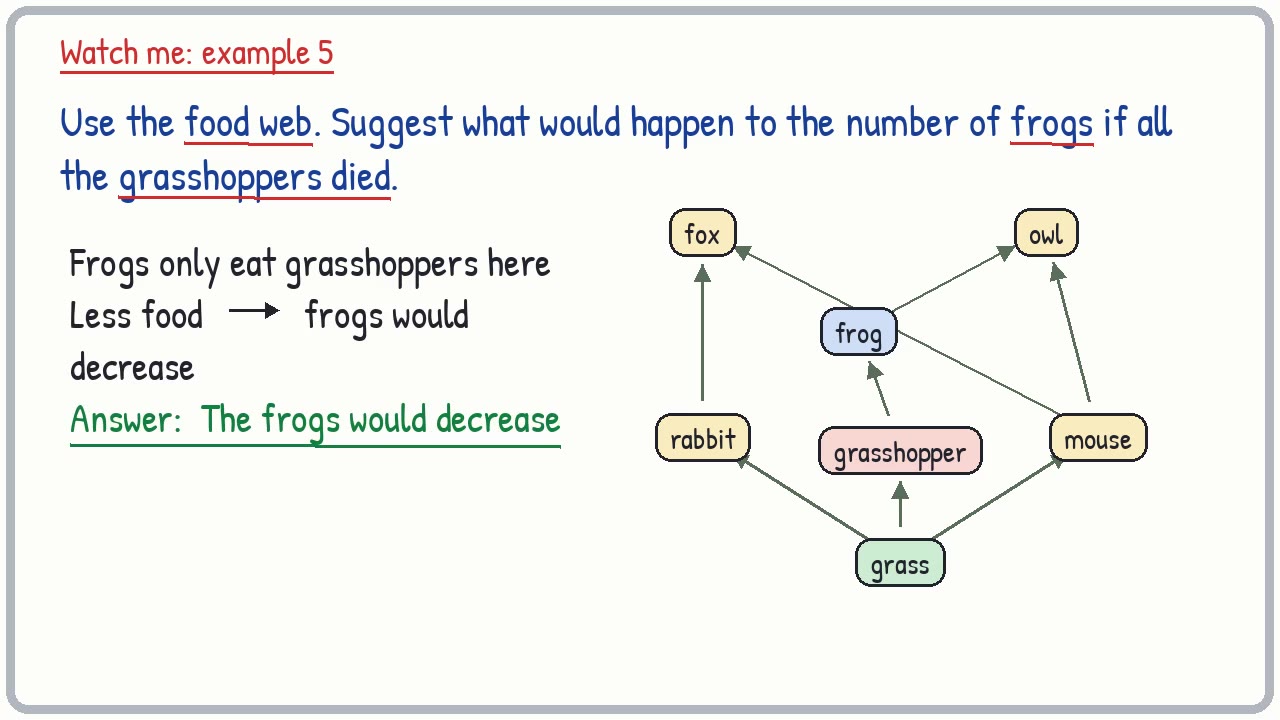
- Use food webs to predict the effect of changes
- Explain why energy is lost along a food chain
- Describe bioaccumulation
The method
- Arrows in a food chain show the flow of energy, pointing to the eater.
- Producer → primary consumer → secondary consumer → top predator.
- In a food web, changing one species affects others (interdependence).
- Energy is lost at each level; poisons build up along a chain (bioaccumulation).
Key words: food chain, food web, producer, consumer, herbivore, carnivore, predator, prey, interdependence, bioaccumulation.
Worked examples
The first three practice questions from the lesson, with every step.
Question 1
What is a producer?
- Step 1: An organism that makes its own food
- Step 2: Usually a green plant, by photosynthesis
Answer: An organism that makes its own food (e.g. a plant)
Question 2
What is a consumer?
- Step 1: An animal that eats other organisms
Answer: An organism that eats other organisms
Question 3
What is the difference between a herbivore and a carnivore?
- Step 1: Herbivore: eats plants
- Step 2: Carnivore: eats animals
Answer: Herbivores eat plants; carnivores eat animals