Year 8 · Science · Light and sound · Lesson 1
Sound waves
How sound is made and travels, amplitude and loudness, frequency and pitch, the speed of sound in different materials, and echo calculations.
24-minute video lesson
Teaching, worked examples and 20 practice questions solved step by step.
Watch free for a monthWhat your child will learn
- Describe sound as a vibration
- Explain why sound can't travel through a vacuum
- Link amplitude to loudness and frequency to pitch
- Compare the speed of sound in solids, liquids and gases
- Calculate distances using echoes
The method
- Sound is made by vibrations and travels as a longitudinal wave through solids, liquids and gases (not a vacuum).
- Bigger amplitude means louder; higher frequency (Hz) means higher pitch.
- Distance = speed × time; sound is about 340 m/s in air.
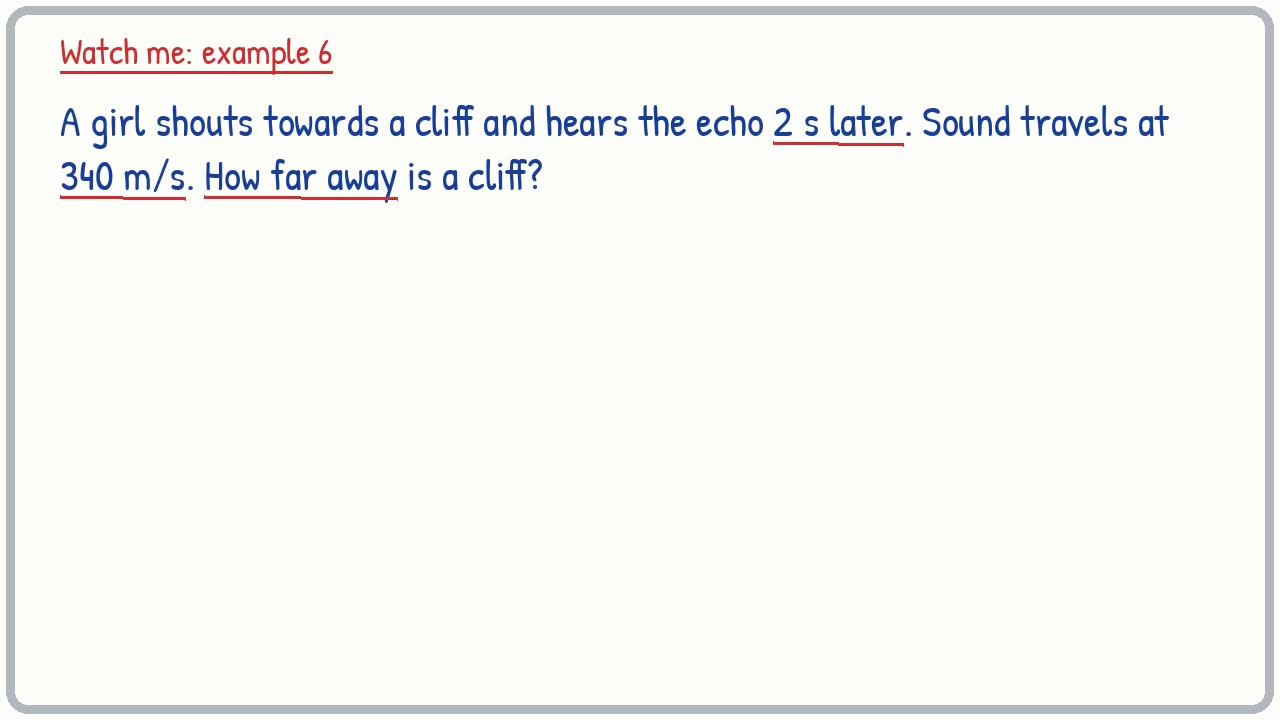
- For an echo, the sound travels there and back, so halve the total distance.
Key words: vibration, longitudinal wave, amplitude, frequency, hertz, pitch, vacuum, echo, ultrasound.
Worked examples
The first three practice questions from the lesson, with every step.
Question 1
What unit is frequency measured in?
- Step 1: Hertz (Hz)
- Step 2: 1 Hz = 1 vibration per second
Answer: Hertz (Hz)
Question 2
What does the amplitude of a sound wave tell you?
- Step 1: How loud it is
- Step 2: Bigger amplitude → louder
Answer: How loud the sound is
Question 3
What does the frequency of a sound wave tell you?
- Step 1: Its pitch
- Step 2: Higher frequency → higher pitch
Answer: Its pitch