Year 8 · Science · Light and sound · Lesson 2
The ear and hearing
The parts of the ear and how we hear, loudness in decibels, how hearing is damaged and protected, and the hearing ranges of humans and animals.
24-minute video lesson
Teaching, worked examples and 20 practice questions solved step by step.
Watch free for a monthWhat your child will learn
- Label the parts of the ear
- Describe how we hear
- Describe loudness in decibels
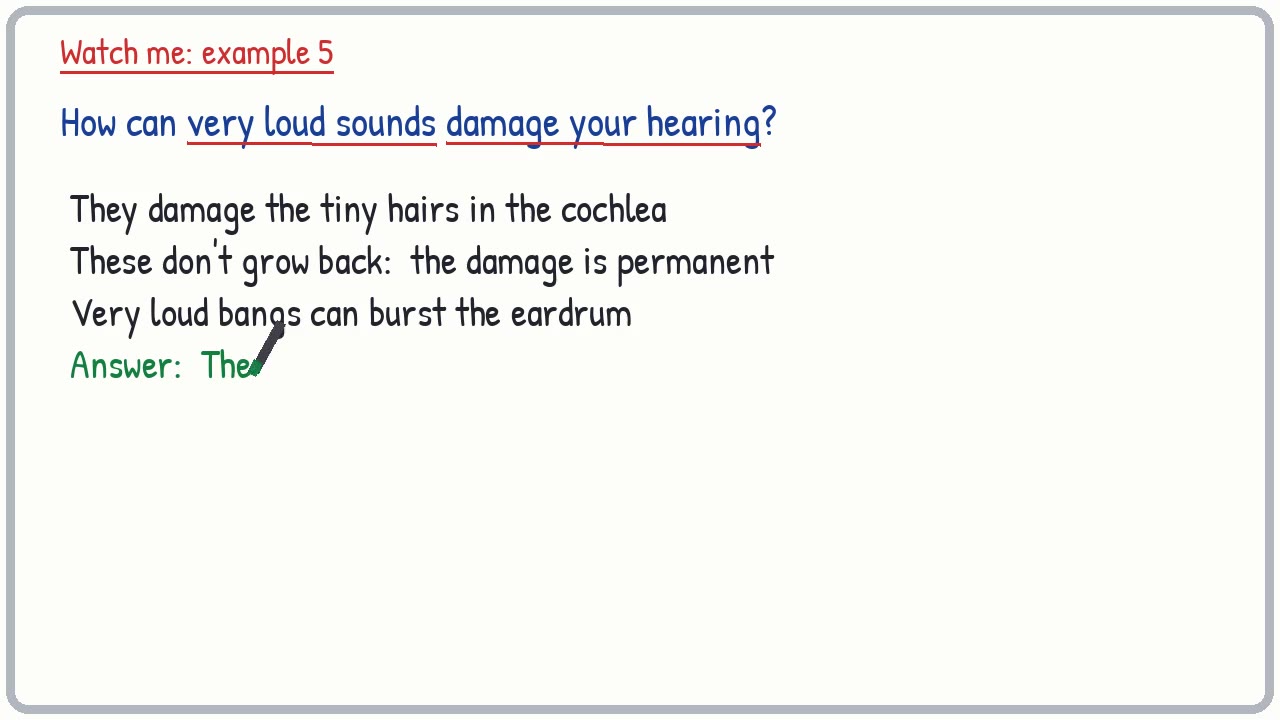
- Explain how hearing can be damaged and protected
- Compare hearing ranges of different animals
The method
- Sound path: ear canal → eardrum → ossicles → cochlea → auditory nerve → brain.
- The cochlea turns vibrations into electrical signals; the semicircular canals are for balance.
- Loudness is measured in decibels (dB); above about 85 dB can damage hearing permanently.
- Humans hear 20 Hz to 20 000 Hz; other animals have different ranges.
Key words: eardrum, ossicles, cochlea, auditory nerve, decibel, hearing range, ultrasound, infrasound.
Worked examples
The first three practice questions from the lesson, with every step.
Question 1
Look at the diagram. Name the part labelled A, and give its job.
- Step 1: Find the label
- Step 2: A = cochlea
- Step 3: Turns vibrations into electrical signals
Answer: Cochlea: turns vibrations into electrical signals
Question 2
Look at the diagram. Name the part labelled B, and give its job.
- Step 1: Find the label
- Step 2: B = ossicles
- Step 3: Three tiny bones that pass on and amplify vibrations
Answer: Ossicles: three tiny bones that pass on and amplify vibrations
Question 3
Look at the diagram. Name the part labelled C, and give its job.
- Step 1: Find the label
- Step 2: C = auditory nerve
- Step 3: Carries signals to the brain
Answer: Auditory nerve: carries signals to the brain