Year 8 · Science · Light and sound · Lesson 3
Light and reflection
How light travels, luminous and non-luminous objects, transparent, translucent and opaque materials, the law of reflection and ray diagrams, and mirror images.
25-minute video lesson
Teaching, worked examples and 20 practice questions solved step by step.
Watch free for a monthWhat your child will learn
- Describe how light travels
- Explain how we see objects
- Classify materials as transparent, translucent or opaque
- Use the law of reflection
- Describe the image in a plane mirror
The method
- Light travels in straight lines at 300 000 km/s and can travel through a vacuum.
- We see non-luminous objects because light reflects off them into our eyes.
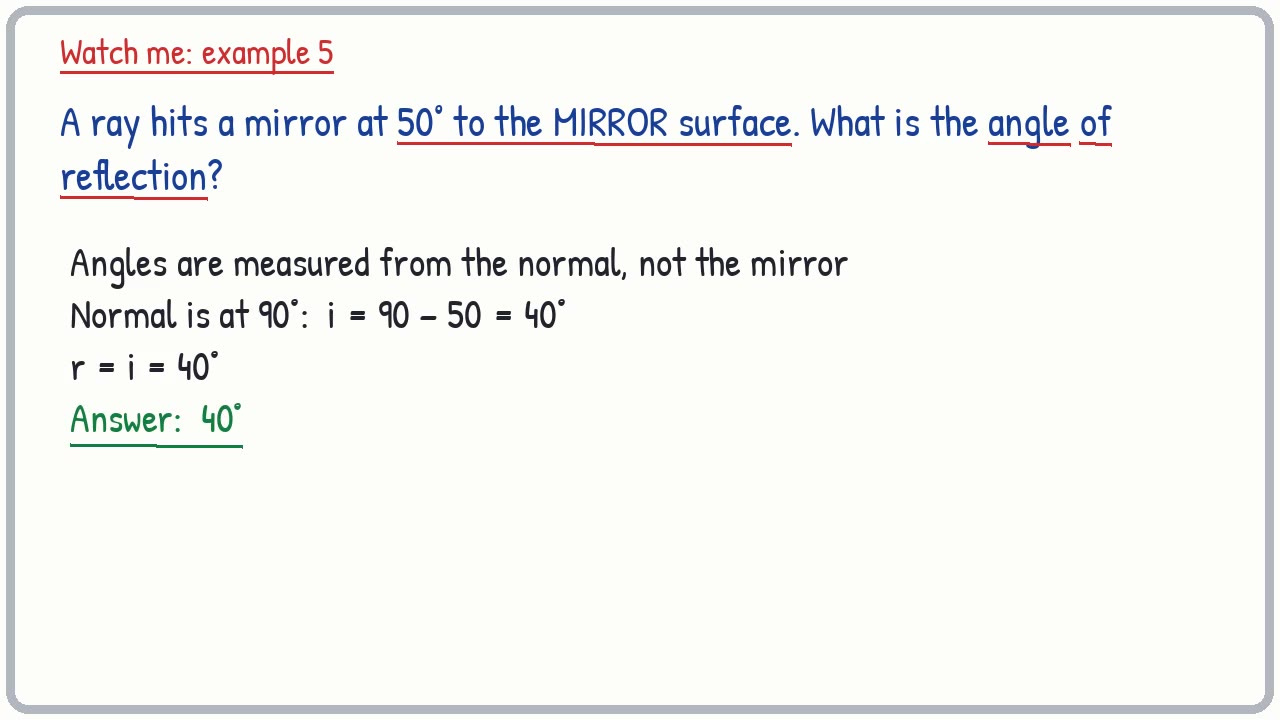
- Law of reflection: angle of incidence = angle of reflection, measured from the normal.
- A plane mirror image is the same size, upright, the same distance behind, and laterally inverted.
Key words: luminous, transparent, translucent, opaque, reflection, normal, angle of incidence, angle of reflection, plane mirror.
Worked examples
The first three practice questions from the lesson, with every step.
Question 1
The angle of incidence on a mirror is 40°. What is the angle of reflection?
- Step 1: Look at the diagram
- Step 2: Law of reflection: i = r
- Step 3: r = 40°
Answer: 40°
Question 2
The angle of incidence on a mirror is 25°. What is the angle of reflection?
- Step 1: Look at the diagram
- Step 2: Law of reflection: i = r
- Step 3: r = 25°
Answer: 25°
Question 3
The angle of incidence on a mirror is 60°. What is the angle of reflection?
- Step 1: Look at the diagram
- Step 2: Law of reflection: i = r
- Step 3: r = 60°
Answer: 60°